The Five Operational Bottlenecks That Silently Slow Business Growth

Updated: 5 days ago
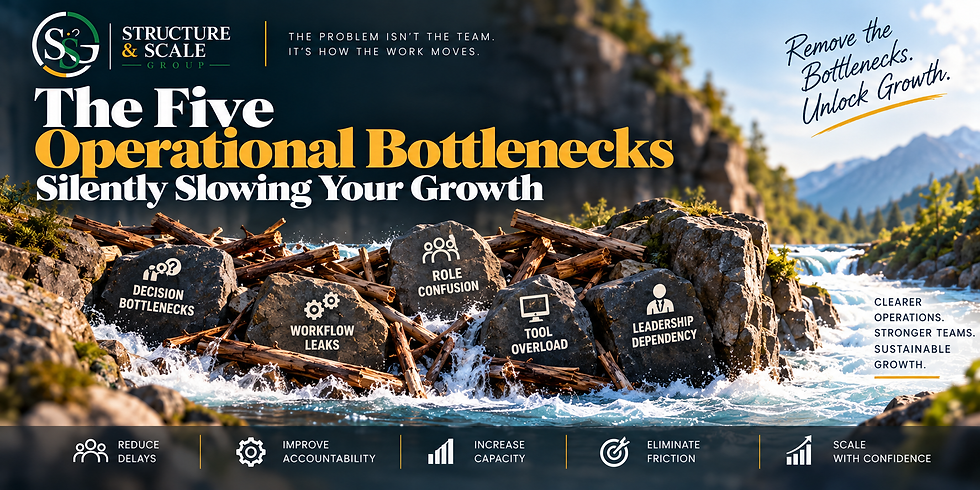
As organizations scale beyond 75 employees, growth creates a new challenge that many leaders don't anticipate.
The problems are no longer obvious.
Revenue may be growing. Customers may be coming in. Teams may be busy. Yet somehow projects move slower, communication becomes harder, and leaders find themselves spending more time solving internal issues than driving the business forward.
The assumption is often that the organization needs more people, better technology, or stronger management.
In reality, most operational breakdowns can be traced back to one or more execution constraints.
These operational bottlenecks create friction inside the business. Left unresolved, they limit scalability, reduce accountability, and force leaders into constant firefighting.
Here are the five execution constraints that plague growing organizations.
1. Decision Bottlenecks
Every organization reaches a point where decisions begin piling up at the top.
Managers wait for approval. Teams hesitate to move forward. Projects stall while leaders attend meetings, answer emails, or resolve competing priorities.
The issue isn't usually a lack of capable people.
It's unclear decision authority.
When employees don't know who owns a decision—or when every decision requires executive involvement—execution slows dramatically.
What it looks like:
Delayed approvals
Constant escalation to senior leadership
Teams waiting for direction
Leaders becoming overwhelmed with operational decisions
If your organization cannot make decisions without a handful of people being involved, growth will eventually outpace execution.
2. Workflow Leaks
Most companies focus on individual departments.
The real challenge lives between them.
Sales hands off to Operations. Operations hands off to Production. Production hands off to Quality. Somewhere in those transitions, information gets lost, delayed, or misunderstood.
These gaps create what we call workflow leaks.
The result is rework, missed deadlines, frustrated employees, and inconsistent customer experiences.
What it looks like:
Work getting "stuck" between departments
Repeated requests for the same information
Missed handoffs
Constant status update meetings
Every workflow leak creates friction. Enough friction eventually becomes a performance problem.
3. Role Confusion
One of the most common symptoms of growth is responsibility drift.
As teams expand, responsibilities evolve faster than job definitions.
People begin assuming someone else owns a task.
Multiple people start working on the same issue.
Critical responsibilities fall through the cracks entirely.
When accountability becomes unclear, performance becomes difficult to measure and even harder to improve.
What it looks like:
"I thought they were handling it."
Duplicate work across departments
Missed deadlines with no clear owner
Managers constantly clarifying responsibilities
Role clarity is not about bureaucracy. It's about creating accountability at scale.
4. Tool Overload
Many organizations don't have a technology problem.
They have a technology consistency problem.
One team uses spreadsheets. Another uses project management software. A third tracks information through email. Critical data lives across multiple platforms, making it difficult to find accurate information when decisions need to be made.
The result is fragmented visibility and operational confusion.
What it looks like:
Multiple versions of the same data
Teams using different systems for similar work
Employees spending more time searching than executing
Reporting that requires excessive manual effort
Technology should simplify execution. When it complicates execution, it becomes a constraint.
5. Leadership Dependency
This is often the most dangerous constraint because it can be mistaken for strong leadership.
Many organizations function because a founder, executive, or manager is constantly stepping in to solve problems.
They answer questions.
They make decisions.
They resolve conflicts.
They push projects across the finish line.
Over time, the organization becomes dependent on them.
The business may continue to grow, but it cannot scale sustainably because execution requires continual intervention from a few key individuals.
What it looks like:
Leaders becoming the default solution for every problem
Teams unwilling to act without approval
Managers overloaded with operational questions
Business performance dropping when specific leaders are absent
If the business cannot operate effectively without you, you don't have a scalable system—you have a dependency.
The Real Cost of Operational Bottlenecks
Most leaders see the symptoms:
Missed deadlines
Slow projects
Communication breakdowns
Employee frustration
Leadership burnout
But symptoms are not the problem.
Execution constraints are.
The organizations that scale successfully aren't necessarily the ones with the most resources. They're the ones who systematically identify and remove the barriers that prevent work from flowing efficiently.
Because sustainable growth isn't created by working harder.
It's created by eliminating the constraints that make execution harder than it needs to be.


Comments